In-class Exercise 3: Working with Open Government Data
Assoc. Professor of Information Systems(Practice)
School of Computing and Information Systems,
Singapore Management University
2025-09-11
Learning Outcome
By the end of this hands-on exercise, you will be able to:
- Preparing ACRA (Accounting and Corporate Regulatory Authority) Information on Corporate Entities datasets downloaded from data.gov.sg portal for geocoding,
- Geocoding the tidydata by using SLA OneMap API,
- Converting the geocoded transaction data into sf point feature data.frame, and
- Wrangling the sf point features to avoid overlapping point features.
Loading the R package
Write a code chunk to install and load tidyverse, sf, tmap and httr into R environment.
Note
httr is an R package specially designed to provide a wrapper for the curl package, customised to the demands of modern web APIs. Key features: Functions for the most important http verbs:
GET(),HEAD(),PATCH(),PUT(),DELETE()andPOST().dplyr is a grammar of data manipulation, providing a consistent set of verbs that help you solve the most common data manipulation challenges. It is a must learned package for modern data scientists and data analysts. Refer to this chapter to learn more about dplyr.
lubridate is an R package specially designed to handle date and date-time data type. Refer to this chapter to learn more about handle date and datetime with lubridate.
Importing ACRA data
Write a code chunk to perform the followings:
- importing an ACRA data set into RStudio as tibble data frame, and
- drop the unnecessary fields such as fields with excessive missing values or fields with only single values.
Saving ACRA data
Tidying ACRA data
Write a code chunk to perform the followings:
- select the target businesses by using SSIC code,
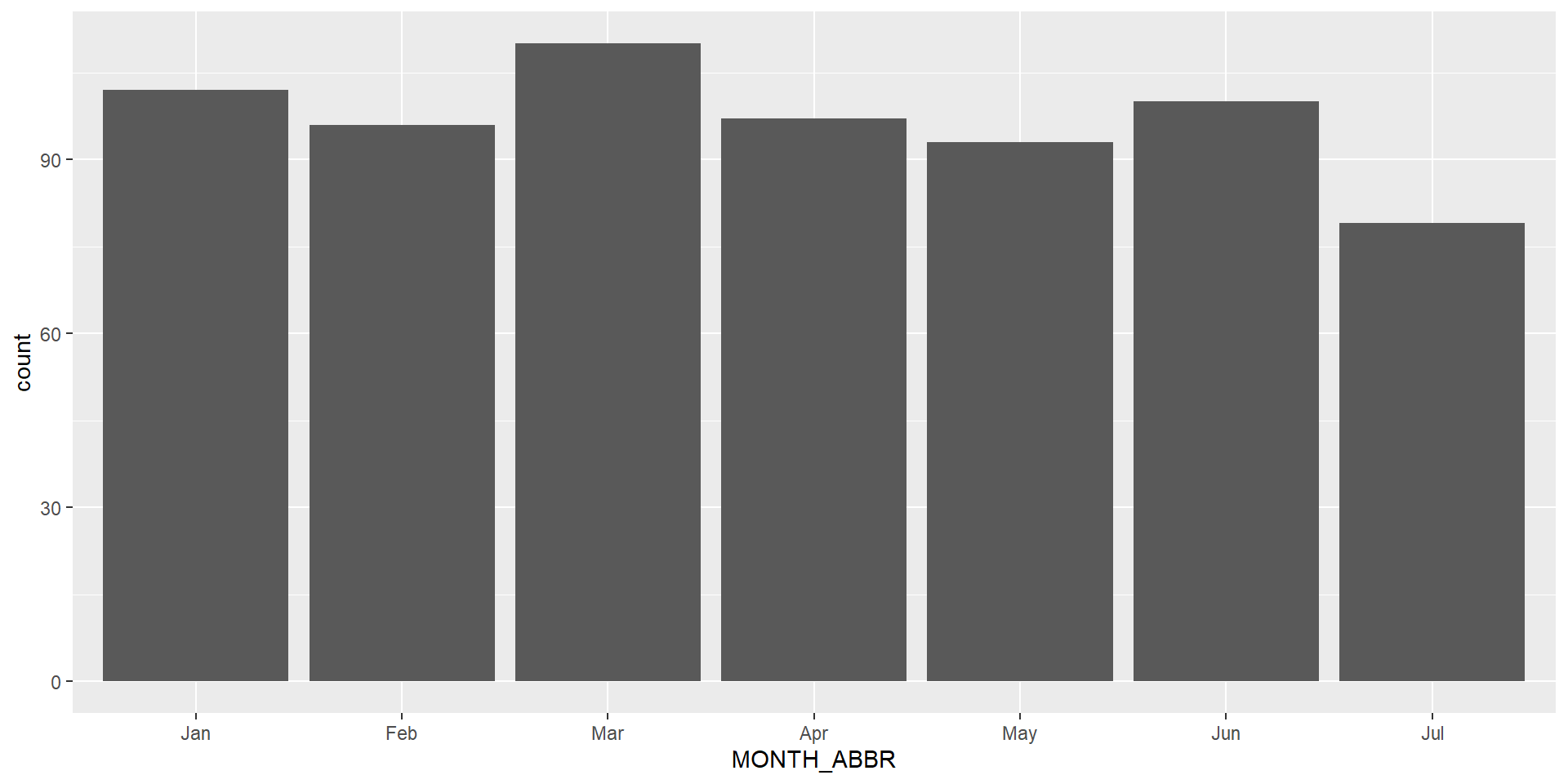
- derive the year and month fields from registration_incorporation_date field,
- tidy postal code values to ensure avoid 5-digit postal codes by mistake, and
- select businesses registered in 2025.
biz_56111 <- acra_data %>%
  select(1:24) %>%
  filter(primary_ssic_code == 56111) %>%
  rename(date = registration_incorporation_date) %>%
  mutate(date = as.Date(date),
         YEAR = year(date),
         MONTH_NUM = month(date),
         MONTH_ABBR = month(date,
                            label = TRUE,
                            abbr = TRUE)) %>%
  mutate(
    postal_code = str_pad(postal_code,
    width = 6, side = "left", pad = "0")) %>%
           filter(YEAR == 2025)
Geocoding
Write a function to perform the following tasks:
- Extracting unique postal code from the postal_code field of the tidied tibble data frame,
- performing geocode by submitting the postal codes to SLA OneMap Reverse Geocode API, and
- save the return results into two data frames namely found (for records that the postal codes are found) and not_found (for record that postal codes are not found).
postcodes <- unique(biz_56111$postal_code)

url <- "https://onemap.gov.sg/api/common/elastic/search"

found <- data.frame()
not_found <- data.frame(postcode = character())

for (pc in postcodes) {
  query <- list(
    searchVal = pc,
    returnGeom = "Y",
    getAddrDetails = "Y",
    pageNum = "1"
  )

  res <- GET(url, query = query)
  json <- content(res)

  if (json$found != 0) {
    df <- as.data.frame(json$results, stringsAsFactors = FALSE)
    df$input_postcode <- pc
    found <- bind_rows(found, df)
  } else {
    not_found <- bind_rows(not_found, data.frame(postcode = pc))
  }
}