Content
- Characteristics of Spatial Interaction Data
- The Huff Model
- The Multiplicative Competitive Interaction (MCI) Model
School of Computing and Information Systems,
Singapore Management University
15 Nov 2025
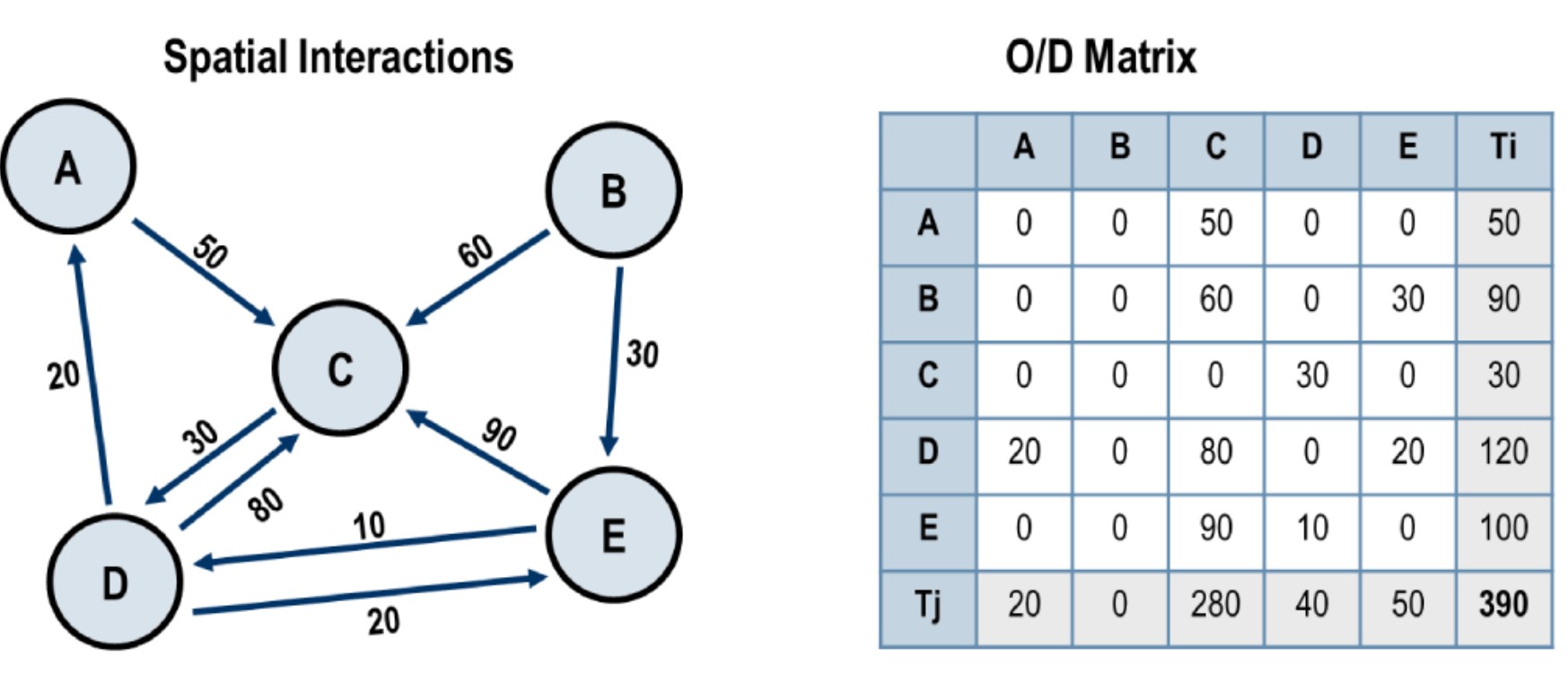
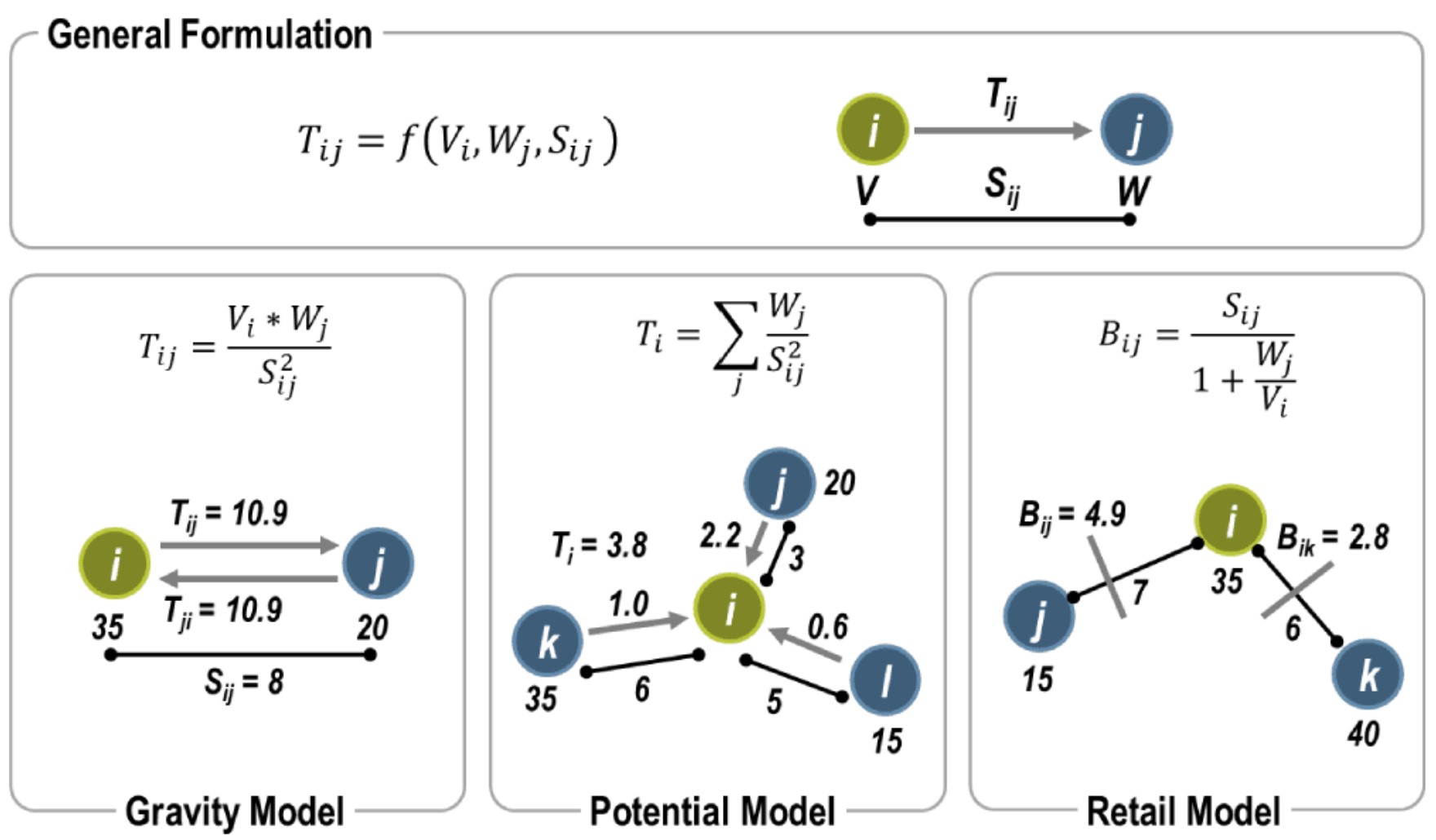
Spatial interaction or “gravity models” estimate the flow of people, material, or information between locations in geographical space.

Note
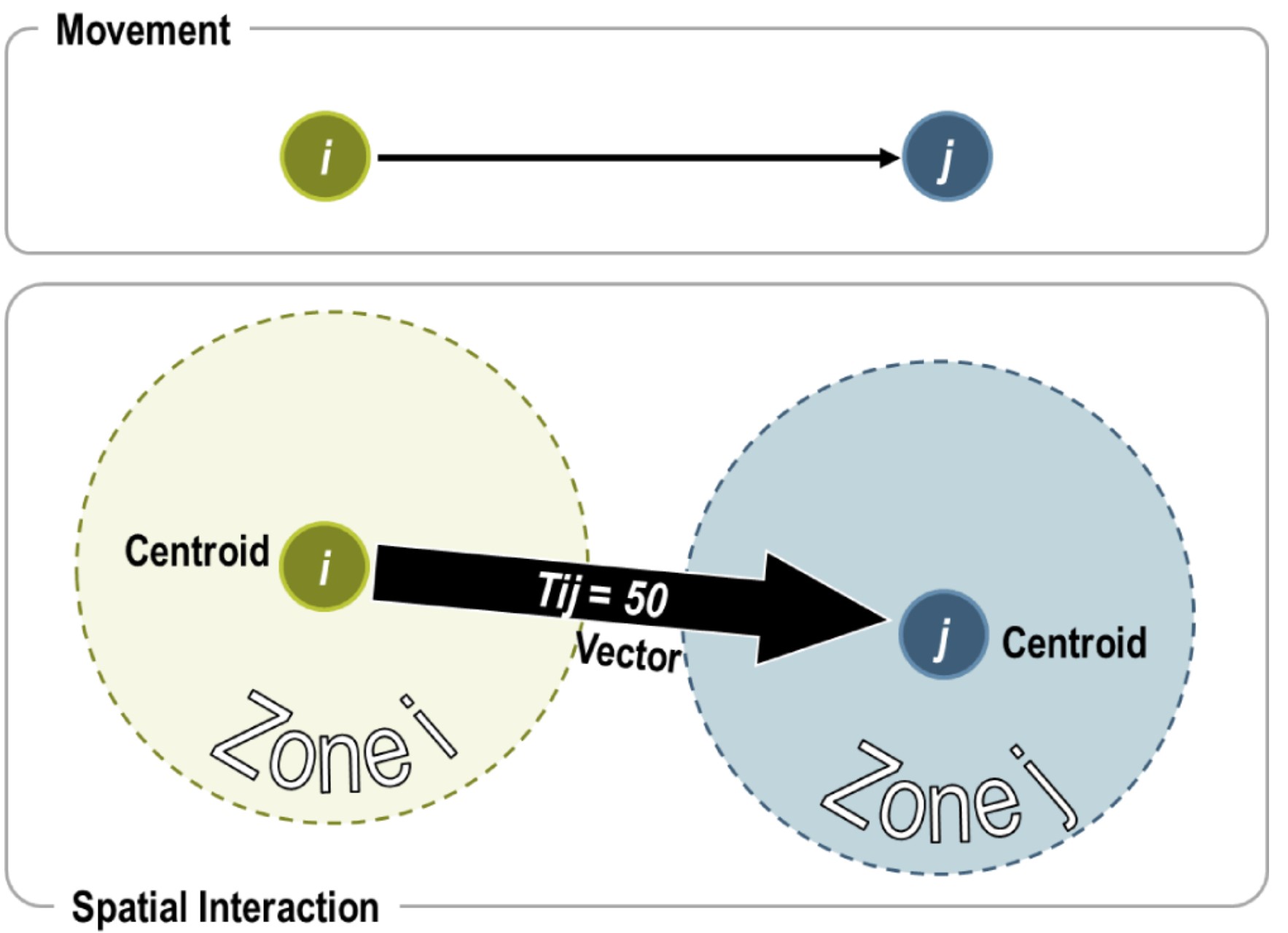
Spatial interaction models seek to explain existing spatial flows. As such it is possible to measure flows and predict the consequences of changes in the conditions generating them. When such attributes are known, it is possible to better allocate transport resources such as conveyances, infrastructure, and terminals.
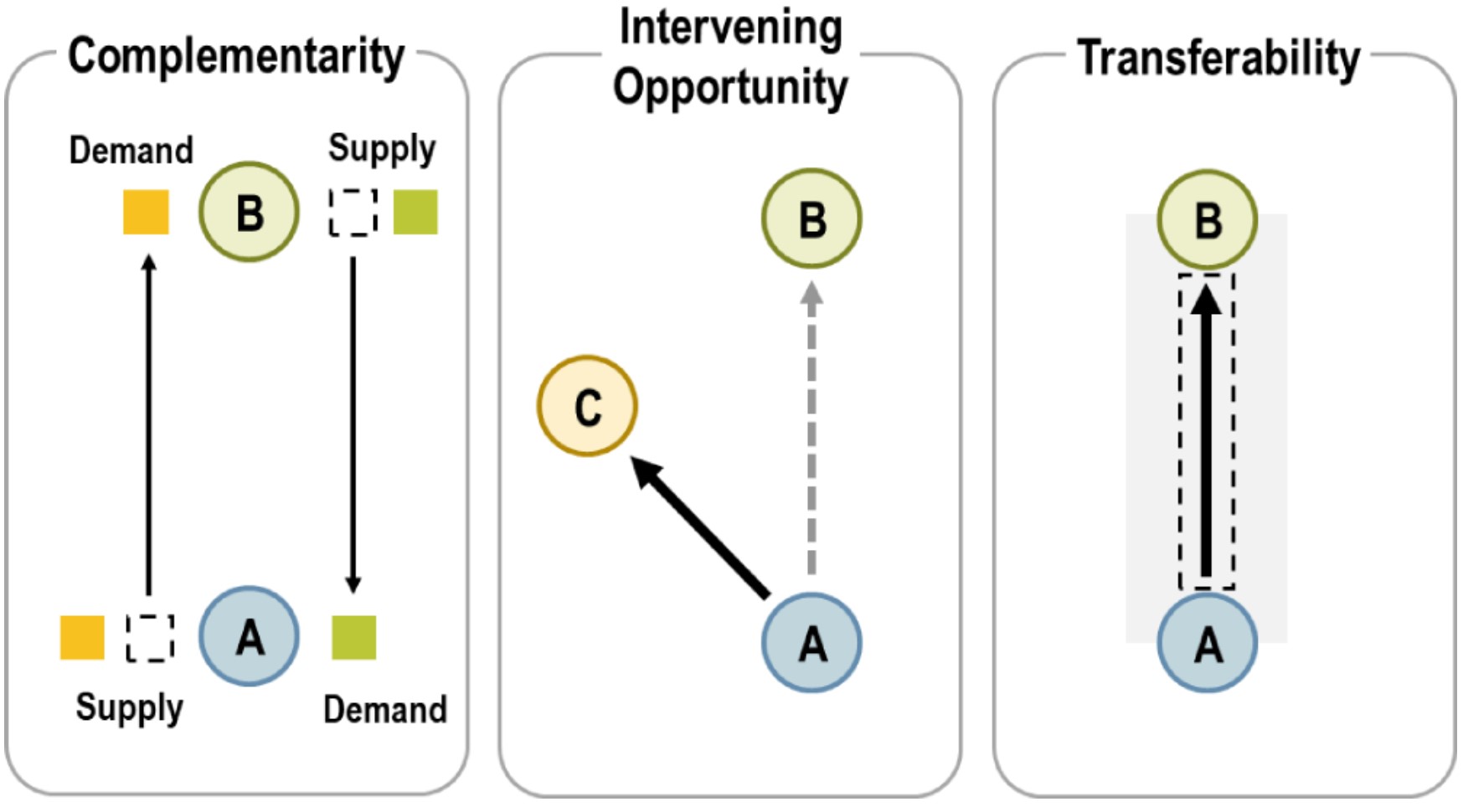
Representing mobility as a spatial interaction involves several considerations:
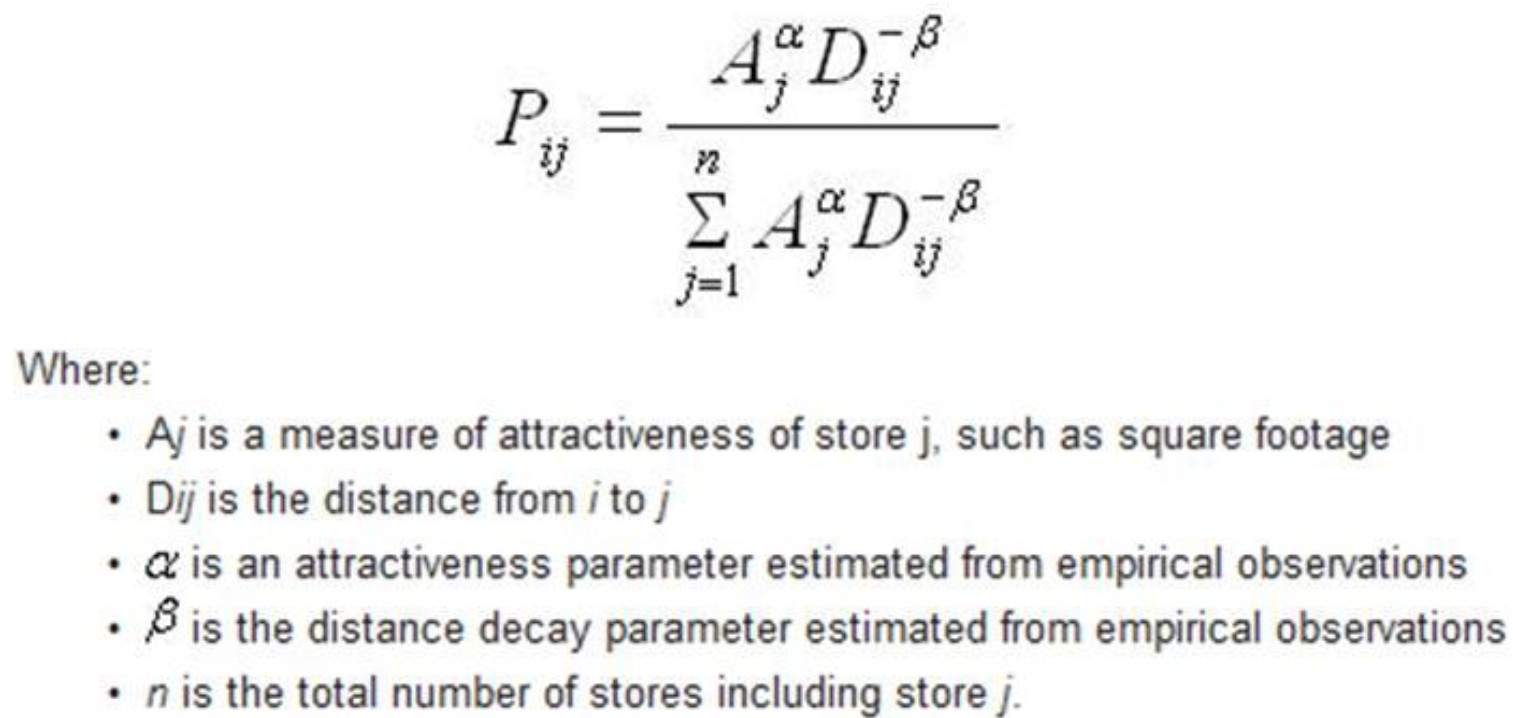
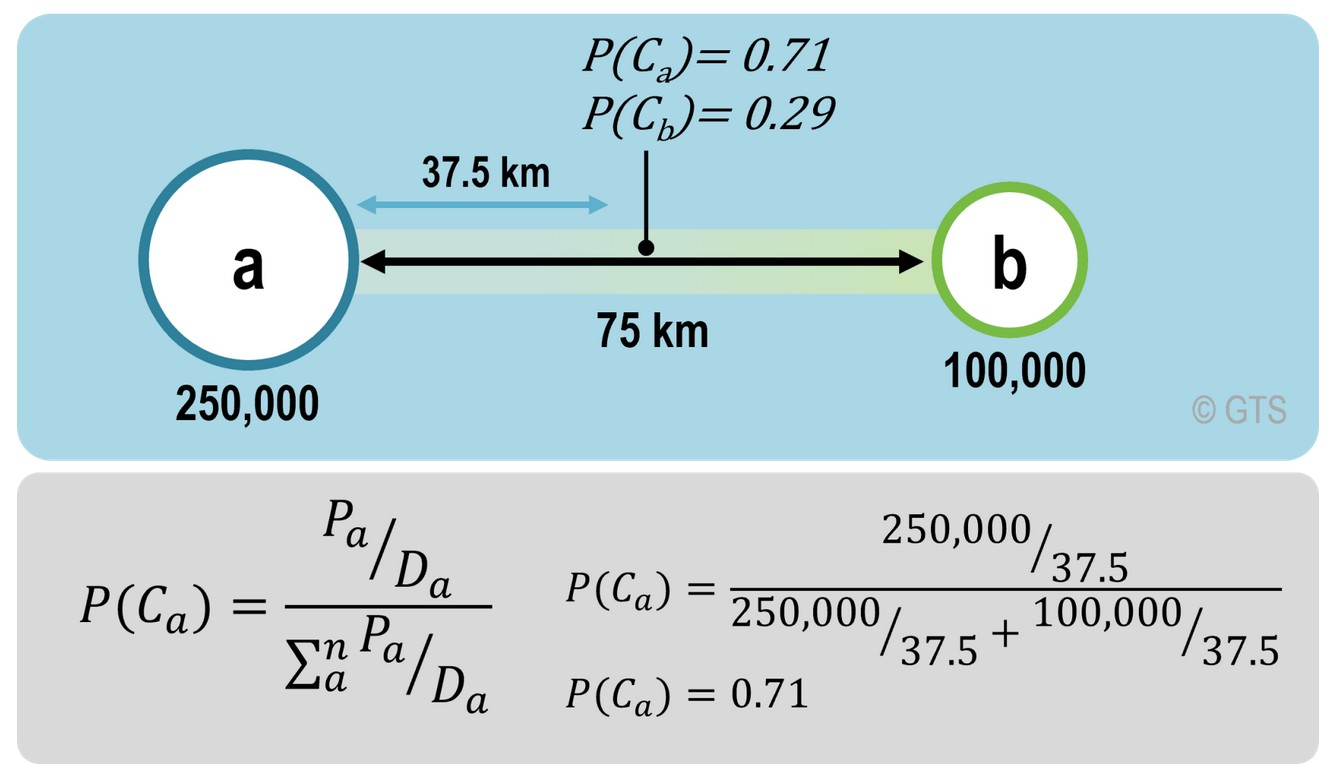
The basis of the Huff Model is the following multiplicative utility function with two explanatory variables representing two determinants of store choice (Huff and Batsell, 1975):
\[ U_{ij} = A^⍺_jd^{-𝜆}_{ij} \]
where:
\(U_{ij}\) is the utility of the supply location \(j\) for the customers at origin \(i\),
\(A_j\) reflects the attraction of supply location \(j\), and
\(d_{ij}\) contains the transport costs customers from \(i\) have to take to reach \(j\).
The exponents ⍺ and 𝜆 are weighting parameters.

These probabilites can be interpreted as market shares of location \(j\) in origin \(i\), what can be called local market shares. These shares implicitly represent a final state of consumer preference patterns in a spatial equilibrium (Huff and Batsell, 1975).
The expected customer/expenditure flows from \(i\) to \(j\) are estimated by multiplying the local market shares with the local market potential (Huff, 1962):
\[ E_{ij} = p_{ij}C_i, \]
where
\(E_{ij}\) is the number of expected customer/purchasing power flows from origin \(i\) to location \(j\), and
\(C_i\) is the total market potential (number of potential customers or purchasing power) in \(i\).
The total sales of each store in the study area can be determine by summing the expected expenditures from each geographical area for all stores. That is
\[ T_j = \sum_{i=1}^{m} E_{ij} \] where \(T_j\) is the market area of \(j\) containing \(m\) submarkets, normally measured in persons or money.
The market share of each store within the study area is each store’s total expected sales divided by the total scales of all stores.
\[ M_j = T_j / \sum_{j=1}^{m} T_j \]
The fundamental theorem behind market share models is the following simple relationship between the competitors’ characteristics and their market shares (Cooper and Nakanishi, 2010):
\[ MS_j =A_j/ \sum_{j=1}^{n} Aj, \]
where \(MS_j\) is the market share of competitor \(j\) and \(A_j\) is the attraction of \(j\). This leads to two characteristics of market shares which are summarized as logical-consistency requirements for market shares: \(0 < MS_j < 1\), and \(\sum_{j=1}^{n} MS_j = 1\), respectively (Cooper and Nakanishi, 2010).
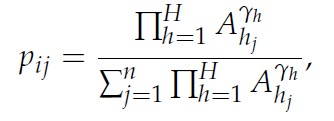
The MCI Model is explicitly formulated to regard a market which is segmented into \(i\) submarkets \((i = 1, ...,m)\) and which is served by \(j\) suppliers \((j = 1, ..., n)\).
The attraction function is multiplicative and consists of \(h (h = 1, ..., H)\) explanatory variables which are weighted exponentially to reflect their sensitivity (Nakanishi and Cooper, 1974):
where:
\(p_{ij}\) is the probability that the customers from submarket \(i\) choose supplier \(j\),
\(A_{h_j}\) is the value of the h-th variable describing the object \(j\),
\(𝛄h\) is the weighting parameter for the sensitivity of \(p_ij\) with respect to the variable \(h\).